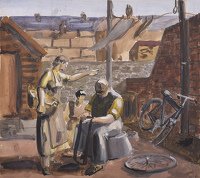
• Army Camp with Nissan Huts, circa 1942 -
    Biography Enquire about this picture£2,800


    Presentation: Framed
    Oil on textured board
    5-1/8 × 11-1/2 in. (13 × 29.2 cm)
    Provenance: Artist’s collection.

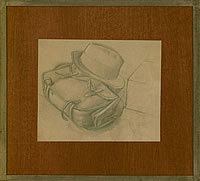
    Lewis served throughout the war as a gunner in the Royal Artillery.When he was off duty he made hundreds of drawings and paintings of army life: I went to so many army camps. I can’t remember which one this is – I had a bit of board one day and did not know what to do with it. I enjoyed the war – plenty of exercise; gave me the opportunity to paint. How many (sketches) I did I really don’t know. It kept me going. I remember when I joined I was always sketching – one of my army colleagues said you’d better give that stuff up until the war’s over. Don’t be so bloody silly, I said. I’m an artist (conversation with Paul
    Liss,May 2008).
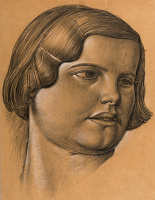
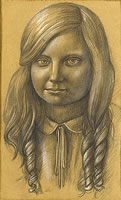
  • Study for Hyde Park, girl standing, circa 1929 -
    Biography Enquire about this picture


    Presentation: Framed
    signed
    Pencil 
    46 x 18 cm
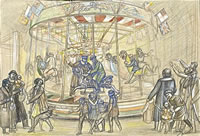
  • The Fun Fair at Newport, circa 1926 -
    Biography Enquire about this pictureTo be included in a
    forthcoming exhibition


    Presentation: Framed

    Signed
    Crayon, pencil and watercolour
    11 3/4 x 17 in.; (30 x 43 cms)

    This composition,  intended as a study for a larger work, was inspired by the Fun Fair which came to Newport twice yearly.   Stanley recalled that he frequently took his sketch book to 'capture the excitement, the movement, the hurley-burley music-the happiness of people escaping from reality'. Some of the character studies were made at Portobello Road.

    Stanley was much inspired by the teaching and facilities of the Royal College of Art and was quick to find his own distinctive voice.  His characterization of figures - verging on, but stopping short of,  caricature -  was to define his most distinctive work from this point on.
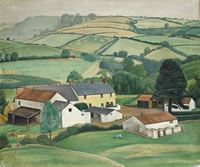
  • Granary Farm, Croesyceiliog, Monmouthshire, 1938 -
    Biography Enquire about this pictureTo be included in a
    forthcoming exhibition


    Presentation: Framed
    oil on canvas
    20 x 24in. (51x61cm.)

    Exhibited: Exhibition of Paintings, Monmouth County Council, (Welsh Arts Council), November 1952, (no. 60); An exhihibition of Contemporary Welsh Painting and Sculpture, The Arts Council of Great Britain, 1955 (75)

    The Granary Farm was adjacent to Whitehall Farm, where Stanley grew up, six miles from the city of Newport in Monmouthshire.  The Granary, which belonged to Mr Gray,  can be seen in the back ground of Stanley's Rome Scholarship entry Allegory (cat. no.   ).

    "After leaving the Royal College, I began teaching at Newport Art School.  I would love to go out into the Countryside to blow the cobwebs out, and I always took my box of paints.  This particular day, the sunlight was glorious, and the sight of Mr Grey's farm enthralled me.  Mr. Gray's farm was adjacent to ours.  It was a beautifully built farm and the foreground with the pigsty, barns, yard, cowsheds, and the house in the middle, utterly magnificent, and separated by the pattern of fields.  I could not resist beginning a painting."
  • Hyde Park - later version, circa 1970 -
    Biography Enquire about this pictureTo be included in a
    forthcoming exhibition


    Presentation: Framed
    signed
    pen and ink and crayon 18 1/4 x 8 in. (46.5 x 20.3 cms).

    In the early 1970's Min Lewis, with the encouragement of  Arnold Haskell, retired Principal of the Royal School of Ballet and distinguished collector of British Twentieth Century Art,  opened a Toy and Pram Museum, in Beckington, near Bath.   As a decorative backdrop to the main display Stanley painted a second, mural, version of Hyde Park  – somewhat in the vein of a Doris Zinkeisen costume drama.

    Haskell and Min co-produced Infantilia - The Archaeology of the Nursery, (published by Dennis Dobson, 1971, illustrated by Stanley.
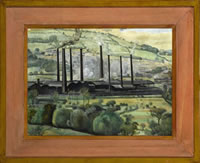
  • Steel Works, circa 1936 -
    Biography Enquire about this pictureTo be included in a
    forthcoming exhibition


    Presentation: Framed

    Inscribed on the reverse Stanley Cornwell Lewis ARCA Principal Carmarthen School Orchard House Lwanstephan Carms.
    oil on 'The Pelham' canvas board
    12x16 in; (30.5 x 40.5 cm.)

    Exhibited: Exhibition of Paintings, Monmouth County Council, (Welsh Arts Council), November 1952, as Baldwins Steelworks, Panteg, Monmouthsire (no. 59)

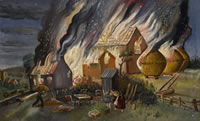
    This painting depicts Alcan Steel Works based in Rogerstone, Newport, Monmouthshire, near Stanley's home. During the war it produced 90% of the aluminum needed for the construction of Aluminum clad aircraft such as Spitfires.

    Stanley Lewis painted the steel works from a nearby hill, where, watching the smoke drifting with the wind, he was 'mesmerised and compelled to paint it'. The steelworks were demolished in 2009.


  • Allegory,  circa 1929 -
    Biography Enquire about this pictureTo be included in a
    forthcoming exhibition


    Presentation: Framed
    Oil on canvas
    50 x 93 in. (127 x 236.2cm.)


    Exhibited: Imperial Gallery of Art, Imperial Insitute South Kensington, Exhibition of Works Submitted in the Competitions for the Rome Scholarships of 1930 in Mural Painting, Sculpture & Engraving, January-February 1930. 

    The Rome scholarship was the highest possible award and the most coveted prize among art students.   Stanley missed winning the 1930 Rome Scholarship in Mural Painting by a  single vote.

    The theme of my painting Allegory is a celebration of simple country life and animals big and small.   I was bought up on a big farm called Whitehall Farm six miles from the city of Newport in Monmouthshire.    As a toddler I was fascinated with all the animals and the goings on, that made up life on a farm in those far off years. The huge horses, shires, the bullocks and cows and the sheep, chickens, ducks, turkeys, pigs, dogs etc and especially the farm workers. My father loved horses and banned horse whips from the farm.

    Stanley started the studies for this picture at home, where he found many of the models - the cowherd with the stick, the reclining figure, (Stanley’s mother), the young woman third from right (Margaret, his sister, born in 1902).  Stanley then took the cartoon to London to complete the oil in the large studios of the RCA. He stayed with his Aunt, Sally Taylor, herself an accomplished painter, in Westgate Terrace, Kensington. Here he found the model for the central figure –a road sweeper who happened to be passing. “I looked out of window saw tall man cleaning street so I got him to pose for a few minutes just so I could get the hang of it.” Other London models followed: Girl with apple cousin Joan, daughter of Aunt Sally. Far right Mrs Cursley – great character; friend of Stanley’s Aunt Sally; lady in waiting to Queen Mary. Seated figure back to viewer: Madame Paul of RA – posed all morning and all afternoon but never naked.

    In the background, Granary Farm which was adjacent to Whitehall Farm, can be seen.  This "....beautifully built farm and the foreground with the pigsty, barns, yard, cowsheds, and the house in the middle..." was the subject of a later painting by Stanley (see cat. no.   ).

    A review of the finalists (undated newspaper clipping) was critical of the fact that "…..there is now some danger of competitors cultivating a Rome Scholarship style, to please the assessors. That the British School at Rome should stand for the classical tradition in art is natural and proper, but classical principles ought not to be confused with classical reminiscences. Take away the reflections of Piero della Francesca and Michelangelo from some of the designs, and there is not very much left.” The review goes on to praise the work of the winner, Marjorie Brooks as being “refreshingly free from the Rome Scholarship manner….”. Of Lewis’s entry the commentator is more critical: “Her nearest competitor is Mr. Stanley C. Lewis, of the Royal College of Art, but his field workers are much more conscious of Rome than of their legitimate business…..”.

    This criticism is ironic given that Stanley Lewis was steeped in the traditions of farming, a love of the land and a deep rooted knowledge of the realities of farm labour. Perhaps his wanted simply to elevate the subject – the daily routine he loved so much. Perhaps he also was too conscious of Monnington, his teacher and mentor, who had won the Rome Scholarship of 1922 with his painting Winter, a composition that must, in part, have been the inspiration for Stanleys Allegory:” Yes, I think I thought a lot about Monnington at that period” Puvis de Chavannes was also at the back of Stanley’s mind: Puvis – had an enormous sense of space In a more general sense their was also the influence of Piero della Francesca and the Quattrocento.   But asked who influenced this work replied: no one. Just wonderful composition. Geometry. Triangles. Underneath that picture its all geometry. The first thing a picture must have is a basis of geometry. Underneath any picture of nature is geometry in my estimation.
  • Cartoon for Allegory, circa 1929 -
    Biography Enquire about this pictureTo be included in a
    forthcoming exhibition


    Presentation: Framed
    Signed
    Pencil with white and green chalk highlights, squared
    50 1/4 x 93 3/4 in. (127.5 x 238 cm.)
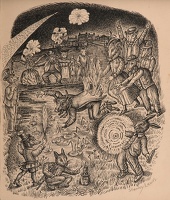
  • Aniaml Town - the complete series of 50  illustrations, 1951 -
    Biography Enquire about this pictureTo be included in a
    forthcoming exhibition


    Presentation: Passe-partout
    Pen and ink
    each 5 1/8 x 5 1/4 in. (13 x 13.5 cm.)

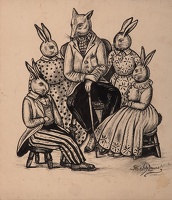
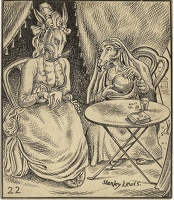
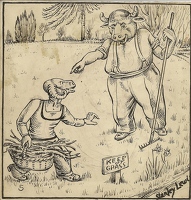
    Done in late 1940's and early 50's, these drawings were published in South Wales Evening Post, to illustrate Children's stories written by Minn.   Stanley recalls that he did “one drawing a day, starting at 6.00 am. I could draw animals off by heart having spent my life on a farm."
  • The Welsh Dresser, circa 1955 -
    Biography Enquire about this pictureTo be included in a
    forthcoming exhibition


    Presentation: Framed

    Signed, Oil on canvas,36 x 22 in.

    Exhibited: Royal Academy 1955 (158); Arts Council of great Britain Welsh Committee, 4th Open Exhibition of Contemporary Welsh Painting and Sculpture 1957,  National Museum of Wales Cardiff, (no. 5)

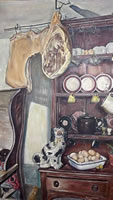
    Stanley was fascinated by Flemish 17th century painting, especially Rembrandt and  Jan Steen, and visited Holland several times.  The joint of ham in this painting was Sally, a family pet pig, who ran riot around the one acre garden at Orchard House in LLANSTEPHAN, until she terrorised and bit MR. RICE the POSTMAN and had to be slaughtered .

    Painted at the suggestion of Min – dresser in the corner of the huge farmhouse kitchen at Orchard House. “THE VAST WELSH DRESSER SO BIG IT MUST HAVE BEEN CONSTRUCTED FOR THE HOUSE IN THE ROOM. IT WAS COLOSSAL. WALKING AND OBSERVING IT I THOUGHT TO MYSELF ‘YES, MIN’S RIGHT, IT WOULD MAKE A GOOD PICTURE’ AND SO I BOUGHT MY FIRST CANVAS AND IT WAS THE FIRST PAINTING I DID AT ORCHARD HOUSE. LATER IT WAS ACCEPTED BY THE ROYAL ACADEMY AND WAS HUNG NEAR CHURCHILL’S BOTTLE SCAPES, AND IN MY OPINION CHURCHILL NEVER GOT THE PERSPECTIVE OF THE CIRCLES RIGHT. NEAR MY PAINTING WAS HUNG THE QUEEN’S PORTRAIT. I placed JENNIFER’S BELOVED BLACK DOLL, SAMBO ON THE OLD WELSH SETTLE AND PLACED THE STAFFORDSHIRE DOG, WHICH I STILL OWN, NEAR THE DISH OF EGGS THAT CAME FROM MY OWN FLOCK OF CHICKENS. I WAS SO AMUSED WHEN I SAW IT AT THE ROYAL ACADEMY AND SAW SALLY OUR WONDERFUL PIG NEXT TO THE QUEEN’S OFFICAL PORTRAIT. I MUST SAY I THOROUGHLY ENJOYED PAINTING THIS PICTURE AND FELT FREE AGAIN, FAR BETTER THAN STRIPPING OLD WALLPAPER AND PLASTER PATCHING AND PAINTING ORCHARD HOUSE’S ENORMOUS ROOMS.”

  • The Welsh Farmer, circa 1953 -
    Biography Enquire about this pictureTo be included in a
    forthcoming exhibition


    Presentation: Framed
    Oil on canvas 40 x 50 in.

    Exhibited RA 1953 as The Welsh Farmer (no?)

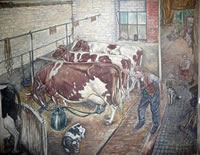
    Although titled The Welsh Farmer when selected for the 1953 Royal Academy Summer show Stanley always referred to this picture as The Cow Shed.  The boy is Stanley's youngest (7 year old) son Michael and his dog Bella; the artist's wife, Min, is seen in the background wheeling a milk church;  the  Farmer is Stephen Thomas who lived next door and helped with cows. The setting is Orchard House – an 18th century building with 300 acres of land of which Stanley and Min retained 15 acres which they ran as small farm.  As part of this Min, with Stephen Thomas's encouragement, turned the  Coach House into a Milk Parlour.

    We made a nice little place – comfortable quarters and all that. Steven rigged her up nicely. Min bought a beautiful dairymaid’s ironed overall. She looked marvellous in it. The she bought a butter churn. A big thing with a handle. We have three  pedigree Ayrshire cows: Flox, Rosie and Sandra. They had lovely big horns because they weren’t dehorned then.
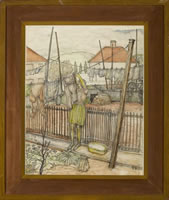
  •  Mr Cole the pigeon man of Llanybri, circa 1955 -
    Biography Enquire about this pictureTo be included in a
    forthcoming exhibition


    Presentation: Framed
    oil on canvas 39 x 31

    Mr Cole was the local road mender in Llanybri. He sold Stanley homing pigeons and bee hives and taught him to spin honey.

    When I moved to Llanstephan I often observed a little man on the side of the road, having his lunch with his tools beside him. I could hear him too, clonking about as he always wore welsh clogs. He was the roadman responsible for roads and ditches from Llanstephan to Llanybri. I asked him to pose for me ....so I could sketch him for a painting. I went up to his place and sketched all the paraphernalia and I painted him on the side of his Garden sitting on a bench outside his House in Llanybri. He told me he was a keen pidgeon fancier, thus I discovered why we had so many pigeons arriving at Orchard House.

     In the background is Mabell Church, the"....sea wet church the size of a snail," to which Dylan Thomas - according to his daughter Aeronwy -  refers in his Poem in October (1946). Stanley fought a longstanding campaign to save the church but it was demolished in 1960.
  • Colour study for the central group of Allergory, circa 1930 -
    Biography Enquire about this pictureTo be included in a
    forthcoming exhibition


    Presentation: Framed
    Oil on canvas
    117 x 57in. (287x 144.8cm.)

    For the Rome scholarship each applicant was required to produce the following:

    Stanley recalls that “I painted the big picture on a s step ladder!”

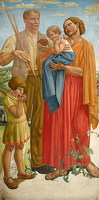
    The theme of this painting is  man and nature - symbolized by the man holding the hedgehog – living in harmony.….. The hedgehog represents the extraordinary life in the countryside.  The pictures theme is a celebration of simple country, country life and animals big and small."

  • Hyde Park in Summer 1931 -
    Biography Enquire about this pictureTo be included in a
    forthcoming exhibition


    Presentation: Framed
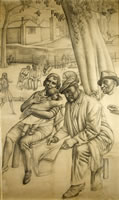
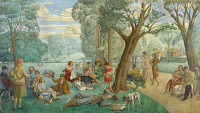
    Oil on canvas 48 x86 3/4 in. (122 x 220.2 cm.) Exhibited: Imperial Gallery of Art, Imperial Insitute South Kensington, Exhibition of Works Submitted in the Competitions for the Rome Scholarships of 1932 in Mural Painting, Sculpture & Engraving, January-February 1932 (winner: xxxxx)??? Stanley entered the 1932 Rome Scholarship in Mural Painting under the insistence of Rothenstein who was convinced that Lewis, having been runner up two years earlier, was capable this timing of winning. Still under the age of 25, by a matter of weeks, he was still just eligible to enter, but this would be his last chance. Accordingly he asked the director of education at Newport, where was already teaching, for three months off. I thought I would never get the chance to enter the Prix de Rome again but Rothenstein kept writing letters to me and encouraged me to enter adding, "you;ll win next time". Stanley prepared initial studies and cartoon at home, Llwyn-On, and then moved to London to complete canvas during first few months of 1931. Stanley knew Hyde Park well from his days at the Royal College of Art -he loved going their to sketch . The subject - a metropolitan scence - makes an interesting pendant to Allegory. The two pictures might be seen as a discourse between Town and Country. The overtly modern subject might also have in some way been chosen by Stanley to answer his critics: that "his field workers are much more conscious of Rome than of their legitimate business….”. The figures on Hyde Park show no such weakness. The painting gives a remarkable account of a summers day in Hyde Park. Lewis himself appears centre stage, reclining, his sketching bag to hand. Lewis recalls that his mother and sister made fun of his plus fours, which he bought for riding his Raleigh bike across London. The composition was partly inspired by Seurat’s Le Grande Jatte in the National Gallery – Lewis admired Seurats strong silhouettes “dark figures against the sky”. Stanley was also aware of paintings by other artists such as Philip Conard (a reproduction of whose 1923 R.A Exhibit Kensington Gardens xxxxxxxxx see fig he kept in one of his scrap books ) . It is also highly likely than Stanely had in mind Percy Horton's composition Kensington Gardens (1923), Horton having been a teacher at The Royal College of Art, (see fig. ). The painting compares well with these compositions. That it was only awarded third place however in the Rome Scholarship is perhaps not surprising - the life-size scale of large scale cartoon (cat ) works wonderfully well but the finished oil makes a better easle painting rather than a mural. The painting is in fact closer in spirit to a Breughal – it has the feel of a busy easel painting rather than static classicism of a mural. The models for the painting were mostly people Stanley saw in the park – “real people are often like that – groups of people enjoying themselves”. He visited the Park early each morning to sketch the down and outs who slept there at night. From numerous pocket book sketches Stanley worked his figure studies up at his lodgings near Redcliffe Gardens. The man seated on the far right, reading, was Stanley’s father. Stanley sourced other figures from his pocket book, “Look at Albrecht Durer – he never left the house without a sketch book –recording a broken wall, a tree, a figure walking.” Some of the models Lewis used were from Newport. Many of the children were from Croesycieiliog. Mrs Roberts doing needlework (seated in red), Clifford Barry, one of Stanley’s students at Newport who Stanley considered to be a fine watercolourist, (seated extreme right smoking and mid left drinking from a flask). The old lady seated in profile on the left was a Royal College of Art Model. The fashionable lady holding an umbrella arm in arm with a gentleman in a top hat was Miss Muriel Pemberton, later head of fashion at St. Martins (a post she held until she retired). At the time Lewis was courting her; she glances back coquettishly towards him. Pemberton also served as the model for the seated central figure with the Japonese parasol which Stanley recalls going to buy as a compositional devise, to add colour, from Woolworths.  The figure in a red beret holding Stanley’s bicycle is his sister Margaret. His young cousin Joan, (daughter of Aunt Sally) is playing with a hoop- she was also the model for the girl eating an apple in Allegory, Stanley's first attempt at the Rome Scholarship. The woman in light blue sitting on the ground and reading a book is a fellow student from the Royal College of Art. The woman seated to the centre left is Stanley's cousin Edith (see cat. no.   ) . As well as making 100s of small sketches of Hyde Park Stanley also used his favourite box Kodak camera to record the Park, sometimessquaring) up the photographs (see cat. no.).
    Hyde Park in Summer also refered to by Stanely as simply The Park – Study for a large Mural Decoration.

  • Cartoon for Hyde Park c.1930 -
    Biography Enquire about this pictureTo be included in a
    forthcoming exhibition


    Presentation: Framed
    Pencil with highlights in white chalk and wash.
    48 x 85in. (122 x 216cm)

    This drawing – described by Stanley as a full scale detail in black chalk – gives an idea of the intended scale of his Hyde Park mural.

    I carried out the cartoons in pencil and charcoal. I gridded them and squared them up for transferring onto canvas. I loved the drawing and painting came next. When I think now I am amazed at my perseverance at hauling my work around the many houses I have lived in. 70 years! It is a miracle they have survived.
  • Study for Allegory -  girl eating apple, c1929 -
    Biography Enquire about this pictureTo be included in a
    forthcoming exhibition


    Presentation: Unframed
    Oil on canvas
    171/2 x 15 1/2in. (44.5x39.5cm.)

    For the Rome Scholarship Stanley submitted a number of preparatory studies in oil, of which this is one of them ,"....a small study of Joan crunching at an apple, painted on hard board."
  • Industrial buildings, with plane overhead  in sky -
    Biography Enquire about this pictureTo be included in a
    forthcoming exhibition


    Presentation: Framed

  • Farm buildings -
    Biography Enquire about this pictureTo be included in a
    forthcoming exhibition


    Presentation: Framed

  • Portrait of a Ploughman , circa 1936 -
    Biography Enquire about this pictureTo be included in a
    forthcoming exhibition


    Presentation: Unframed
    Oil on canvas
    approx 20 x 15 in.

    Exhibited: Royal Academy (452); Royal West of England Academy Bristol 1938

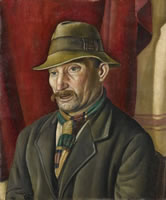
    This portrait of Henry, a farm worker at Llanyravon, is a study for the painting The Welsh Mole Catcher, 1937 (see cat. no.   )
  • Sheet of studies for Hyde Park, circa 1929 -
    Biography Enquire about this pictureTo be included in a
    forthcoming exhibition


    Presentation: Unmounted
    6 drawings mounted together by the artist for the 1930 Rome School Competition
    Coloured chalks and pencil
    overall (approx) 60 x 80 cm
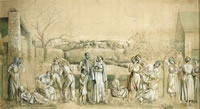
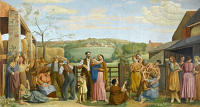
  • Whitehall Farm, circa 1929 -
    Biography Sold


    Presentation: Framed
    Pen and ink and watercolour, 12 × 21 in. (32 × 55 cm.), arched top
    Provenance: Michael Whitehall;Twentieth-Century Gallery, London

    Whitehall Farm was one of two compositions that Lewis prepared for the 1930 Rome Scholarship in Decorative Painting, which he entered on the insistence of William Rothenstein, Principal of the Royal College of Art, having won an entrance scholarship there in 1925. Lewis missed winning the 1930 Rome Scholarship by a single vote.

    ‘I was brought up on a big farm called “Whitehall Farm” six miles from the city of Newport in Monmouthshire. As a toddler I was fascinated with all the animals and the goings-on that made up life on a farm in those far-off years: the huge horses (Shires), the bullocks and cows and the sheep, chickens, ducks,turkeys, pigs, dogs, etc., and especially the farm workers. My father loved horses and banned horse-whips from the farm.

    ‘The background shows only a small section of the buildings – there were huge barns, stables and sheds and a large pool where I sailed my model ships which I made in the carpenter’s shed. On the left is a farm boy carrying hay, andflirting with the maids! Then two men are talking: the old man is Mr Philips, and Albert Hall with horse collar on his right arm. Many jokes were made on Albert’s name, but he took it in good heart. My father is milking the cow in the centre,my sister is holding a pet rabbit,myself doing up laces. My mother sits deeply in thought. The man on the ladder is culling a square of hay from the hayrick. Jim Miles is shown greeting his young wife and baby, and of course the real occupants of the farm – the animals – are all about’ (Letter to Paul Liss, 28 November 2006).
    We are grateful to Jennifer and Beverley Heywood, Stanley Lewis and Kingsley Wood for their assistance.
Thumbnail panels:
Now Loading